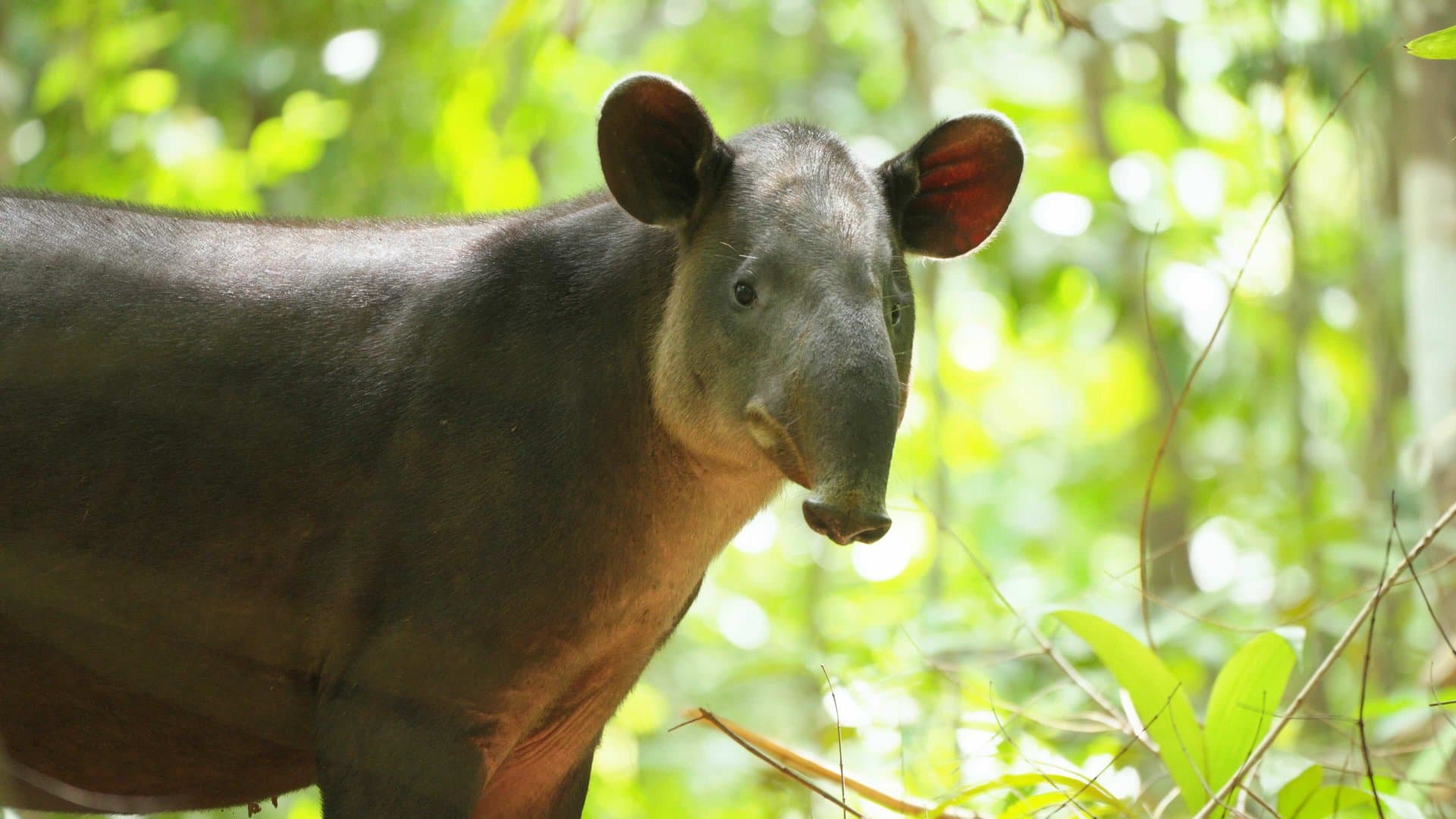
A glimpse into the life of one of Central America's most remarkable and endangered mammals.
Encountering a Baird’s Tapir (Tapirus bairdii) in the wild is a special experience. Despite being the largest native land mammal in Central America, this fascinating animal is surprisingly difficult to observe. It moves quietly through dense vegetation, follows hidden forest trails and often emerges near rivers and natural pools under the cover of darkness.
The video accompanying this article offers a glimpse into the life of this remarkable forest dweller. Beyond the images, however, lies a fascinating story of evolutionary history, ecological importance and an increasingly uncertain future.
What is a Baird’s Tapir?
Baird’s Tapir, also known as the Central American Tapir or Danta, is a large herbivorous mammal belonging to the family Tapiridae. It is one of four living tapir species worldwide and the largest native terrestrial mammal in Central America.
Its most distinctive feature is its flexible, elongated snout, formed by the extension of the upper lip and nose. This short, mobile proboscis works almost like a miniature trunk, allowing the animal to grasp leaves, shoots and fruit while navigating dense vegetation.
Adults can reach approximately two metres in body length and weigh between 150 and 300 kg, although size varies between individuals and populations. Their dark brown to greyish coat, rounded body and pale markings around the cheeks, throat and ear edges make them instantly recognizable.
Despite their bulky appearance, tapirs are remarkably agile. They can move through thick undergrowth, negotiate steep forest terrain and swim with considerable ease.
Distribution: From Mexico to Colombia
Baird’s Tapir inhabits a relatively narrow geographical region extending from southeastern Mexico through Central America to northwestern Colombia.
The species has disappeared from El Salvador and is considered extinct there. Its historical occurrence in Ecuador is also uncertain.
Panama occupies a particularly important position within this distribution. The country forms a natural connection between Central American and South American ecosystems, making its remaining forests important for maintaining habitat connectivity and the potential movement of wildlife populations.
However, the presence of suitable habitat does not necessarily mean that tapirs are still present. Research in Panama has highlighted significant gaps in knowledge about their distribution, with many potentially suitable areas lacking verified records.
Habitat and natural environment
Baird’s Tapirs are strongly associated with natural freshwater sources and extensive vegetation cover. They inhabit a surprisingly wide variety of ecosystems, provided that food, water and suitable shelter are available.
Their preferred habitats include:
- Tropical lowland rainforests.
- Montane and cloud forests.
- Riparian forests along rivers and streams.
- Swamp forests and wetlands.
- Mangroves and seasonally flooded habitats.
- Secondary forests with sufficient vegetation cover.
Although they can occur across a broad elevational range, the availability of water and undisturbed forest habitat is particularly important.
In Panama, large forest landscapes such as Darién and other protected areas are especially relevant to the conservation of this species.
Behaviour and natural history
Baird’s Tapirs are generally solitary animals, although individuals may occasionally interact, particularly during breeding or when food resources are abundant.
They are predominantly nocturnal and crepuscular, becoming more active around dusk and during the night. Nevertheless, daytime observations are possible, especially in areas with little human disturbance.
Their large bodies make them vulnerable to overheating, which helps explain their preference for shaded habitats and their frequent use of water.
A remarkable swimmer
Water plays an essential role in the daily life of a tapir. These animals are excellent swimmers and frequently enter rivers, streams and pools to cool down, escape disturbances and move between areas of forest.
They can even walk along riverbeds and remain submerged for periods of time, using their flexible snout as a snorkel.
A forest herbivore
Baird’s Tapirs are strict herbivores. Their diet includes leaves, young shoots, fruits, flowers, twigs, grasses and aquatic vegetation.
Their flexible snout allows them to select and manipulate food from different levels of vegetation. They often forage while moving slowly through the forest, following established trails and exploring areas with abundant plant growth.
An important seed disperser
One of their most valuable ecological contributions is seed dispersal.
By consuming fruits and subsequently depositing seeds in their dung, tapirs help transport plant species across the forest. Some seeds can remain viable after passing through their digestive system, contributing to forest regeneration.
This makes the Baird’s Tapir an important component of tropical forest ecosystems. Its disappearance could affect ecological processes that extend well beyond the species itself.
Reproduction and the life of a young tapir
Baird’s Tapirs have a relatively slow reproductive rate, which makes recovering from population declines particularly difficult.
After a gestation period of approximately 13 months, females generally give birth to a single calf.
Young tapirs have a distinctive reddish-brown coat covered in white spots and stripes. This striking pattern provides camouflage among patches of sunlight, leaves and vegetation on the forest floor.
As the calf grows, these markings gradually disappear and are replaced by the darker coloration characteristic of adults.
Young tapirs remain dependent on their mothers for an extended period, often staying with them for one to two years. This prolonged maternal care, combined with their long gestation, means that populations cannot quickly compensate for increased mortality.
Conservation status: An endangered species
Baird’s Tapir is classified as Endangered (EN) on the IUCN Red List, with a declining population trend.
Its conservation situation is particularly concerning because populations are naturally sparse and increasingly isolated across its geographical range.
Several major threats contribute to this decline.
1. Habitat loss and fragmentation
Agricultural expansion, cattle ranching, logging, infrastructure development and deforestation are reducing the amount of suitable habitat available to tapirs.
Even where forests remain, roads and other developments can divide large landscapes into smaller, isolated fragments, restricting animal movements and reducing opportunities for populations to interact.
2. Hunting and poaching
Hunting remains a significant threat in several parts of the species' range. Because tapirs reproduce slowly, even relatively low levels of additional mortality can have serious consequences for local populations.
3. Roads and infrastructure
Road construction can fragment habitats, increase human access to previously remote forests and expose wildlife to vehicle collisions.
For an animal that requires large areas of connected habitat, these developments can have long-lasting consequences.
4. Disease transmission
Contact with domestic livestock can expose tapirs to infectious diseases. This is an additional concern where forest habitats overlap with agricultural landscapes.
5. Climate change
Changes in rainfall patterns, increased drought severity and declining freshwater availability may further affect suitable habitats, particularly in landscapes already under pressure from human activities.
Encountering the Baird’s Tapir in the wild
Baird’s Tapir is one of the most remarkable inhabitants of Central America’s forests. Its impressive size, distinctive appearance and secretive behaviour make an encounter with this elusive mammal an unforgettable experience for any wildlife enthusiast.
Spotting a Baird’s Tapir on your own can be an almost impossible task. That’s where BirdnWild comes in! We connect you with expert local guides who know the forests, understand the tapir’s habits and know where and when to look for this elusive species. With their knowledge and expertise, you have a much better chance of experiencing this magical encounter in the wild.
Explore our wildlife tours and discover where you can look for Baird’s Tapir: Discover Baird’s Tapir wildlife tours.
Happy wildlife watching! :)