From iconic colorful giants soaring over the canopy to shy, secretive species hiding in the rainforest understory, Costa Rica’s Caribbean Lowlands are an absolute paradise for birdwatchers and wildlife photographers.
Although historical land clearing altered portions of the original primary rainforest, resilient public and private reserves across the lowlands now safeguard crucial habitat. Today, these protected areas host an extraordinary mix of lowland specialists, regional endemics, and some of the most sought-after species in Central America.
If you are planning a birding itinerary to Costa Rica, here is a detailed breakdown of the incredible avian highlights waiting for you in the Caribbean Lowlands—and how to spot them with local experts.
Canopy Giants & Iconic Species
Great Green Macaw (Ara ambiguus)
The Caribbean Lowlands serve as the critical stronghold for the endangered Great Green Macaw. Thanks to intensive local conservation initiatives and habitat protection focused on their favorite feeding trees (such as the Mountain Almond tree), healthy populations continue to fly free across the region. Watching a pair of these magnificent, vibrant green macaws fly over the forest canopy is a highlight of any trip.
Find tours where you may see the Great Green Macaw
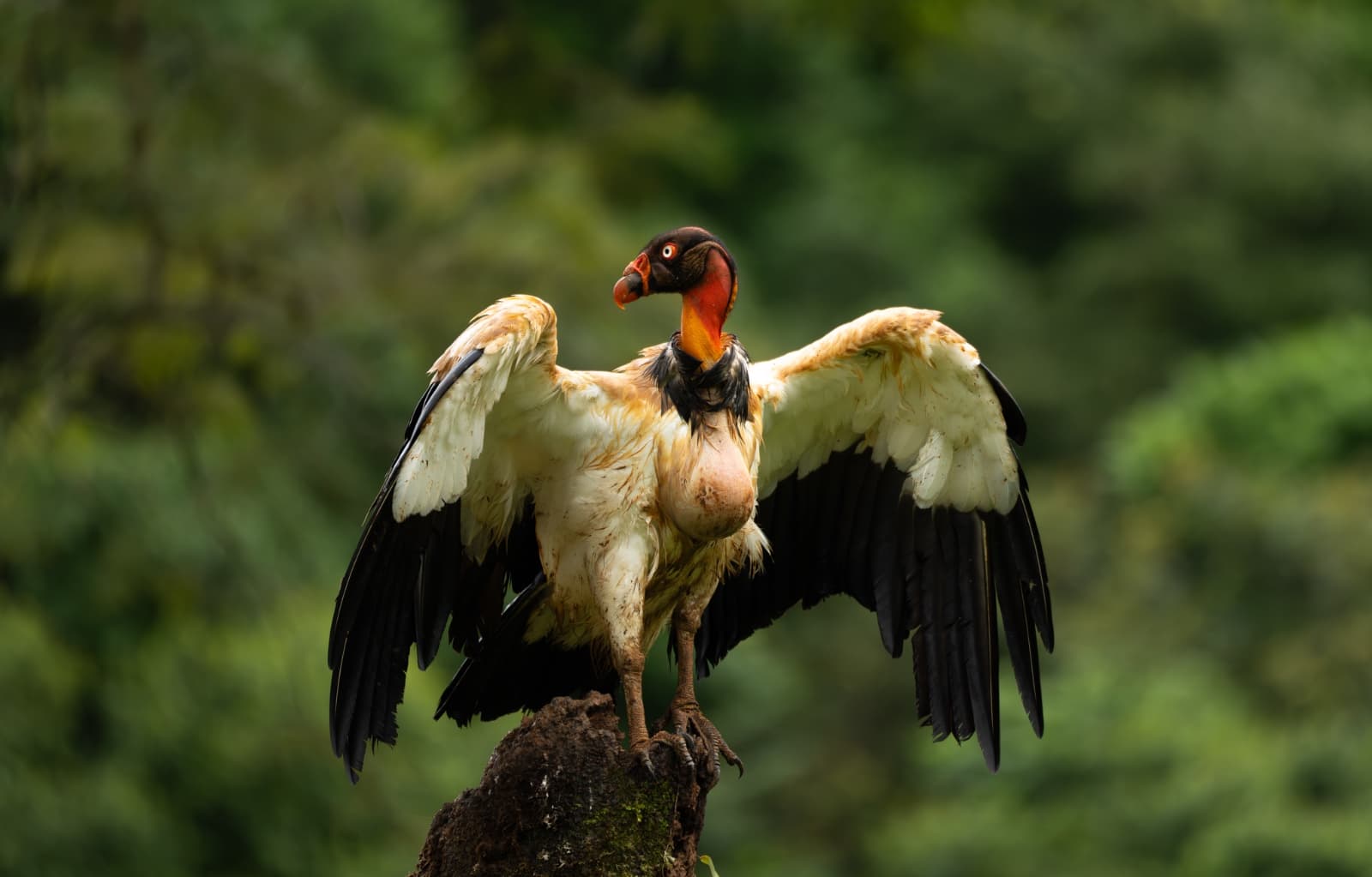
King Vulture (Sarcoramphus papa)
While the King Vulture occurs across Central and South America, Costa Rica's Caribbean region provides one of the single best opportunities in the world to observe and photograph this majestic bird up close. Whether encountered scavenging in wild forest clearings or photographed from dedicated wildlife hides, seeing their striking white plumage and vividly colored, intricate head features at close range is unforgettable.
Find tours where you may see the King Vulture
Keel-billed Toucan (Ramphastos sulfuratus)
The Caribbean Lowlands are home to three distinct toucan species, most notably the iconic Keel-billed Toucan. Famous for its oversized, rainbow-hued bill, it stands as one of Costa Rica's most photographed birds. While commonly encountered throughout mature forest, local bird gardens and specialized photography setups offer unmatched close-up shooting opportunities.
Find tours where you may see the Keel-billed Toucan
Rare Sightings & Hidden Gems
Agami Heron (Agami agami)
Often considered one of the world's most beautiful yet elusive wading birds, the solitary Agami Heron is notoriously difficult to track in deep swamp forests. However, during the breeding season, they gather in dense, dramatic nesting colonies. The Caribbean Lowlands host some of the most accessible and impressive Agami Heron colony sites known anywhere in their range, creating once-in-a-lifetime photo opportunities.
Find tours where you may see the Agami Heron
Central American Pygmy-Owl (Glaucidium griscomi)
In nature, nothing goes to waste. When woodpeckers—such as the regional Chestnut-colored Woodpecker or the range-restricted Rufous-winged Woodpecker—abandon their nesting cavities, tiny opportunists move in. The miniature Central American Pygmy-Owl often takes up residence inside these old woodpecker holes to raise its brood.
Find tours where you may see the Central American Pygmy-Owl
Rare & Range-Restricted Specialties
-
Tawny-chested Flycatcher: A true birding challenge. Restricted strictly to Costa Rica and extreme southern Nicaragua, this rare species is tough to find anywhere within its limited footprint.
Find tours for Tawny-chested Flycatcher -
Rufous-winged Woodpecker: Found mostly on the Caribbean slopes and lowlands between Honduras and Western Panama.
Find tours for Rufous-winged Woodpecker - Stripe-breasted Wren & Streak-crowned Antvireo: Forest specialists that move through the dense lower to mid-canopy strata.
-
Dusky-faced Tanager: Unlike open-country tanagers, this species prefers dense rainforest understory, traveling in noisy family parties.
Find tours for Dusky-faced Tanager -
Nicaraguan Seed-Finch: Found in open grasslands, highlighting how the Caribbean Lowlands embrace both deep rainforest habitats and open meadows.
Find tours for Nicaraguan Seed-Finch
Best Birdwatching Locations in Costa Rica’s Caribbean Lowlands
To make the most of your birding trip, focusing on key hotspots across the region is essential. Each location offers access to distinct habitats, specialized photography hides, and high species diversity:
1. Sarapiquí
Surrounded by pristine rainforest reserves—including the world-renowned La Selva Biological Station alongside several private sanctuaries—Sarapiquí is the ultimate base for exploring the region's avian diversity. It is arguably the best place in Costa Rica to observe and photograph the endangered Great Green Macaw in its natural feeding grounds.
Explore birdwatching tours in Sarapiquí
2. La Fortuna
Boasting an exceptional network of public and private reserves, La Fortuna sits strategically at the intersection of the Caribbean lowlands and rainforest foothills. This unique position allows birdwatchers to easily explore two distinct ecosystems in a single trip, targeting both lowland specialists and foothill endemics.
Explore birdwatching tours in La Fortuna
3. Boca Tapada
A world-class paradise for wildlife photographers! Situated near the northern border, Boca Tapada is famous for its specialized birds photography opportunities. It is one of the premier locations in Central America to photograph the King Vulture, Keel-billed Toucan, and the spectacular Northern Royal Flycatcher at remarkably close range.
Explore bird photography tours in Boca Tapada
4. Caño Negro
As one of Costa Rica's most vital wetland ecosystems, Caño Negro offers an unbeatable experience for spotting waterbirds and species adapted to open, flooded river basins. Take a boat tour along the waterways to discover specialized marshland birds, kingfishers, herons, and migratory species.
Explore birdwatching tours in Caño Negro
5. Río Celeste Area
Nestled between rainforest foothills and lowland wetlands, the Río Celeste region offers rich ecological diversity. Most notably, this area is the premier destination to observe and photograph the elusive Agami Heron during its spectacular breeding season at local nesting colony.
Explore birdwatching tours in Río Celeste Area
Happy Birding & Wildlife Observation!