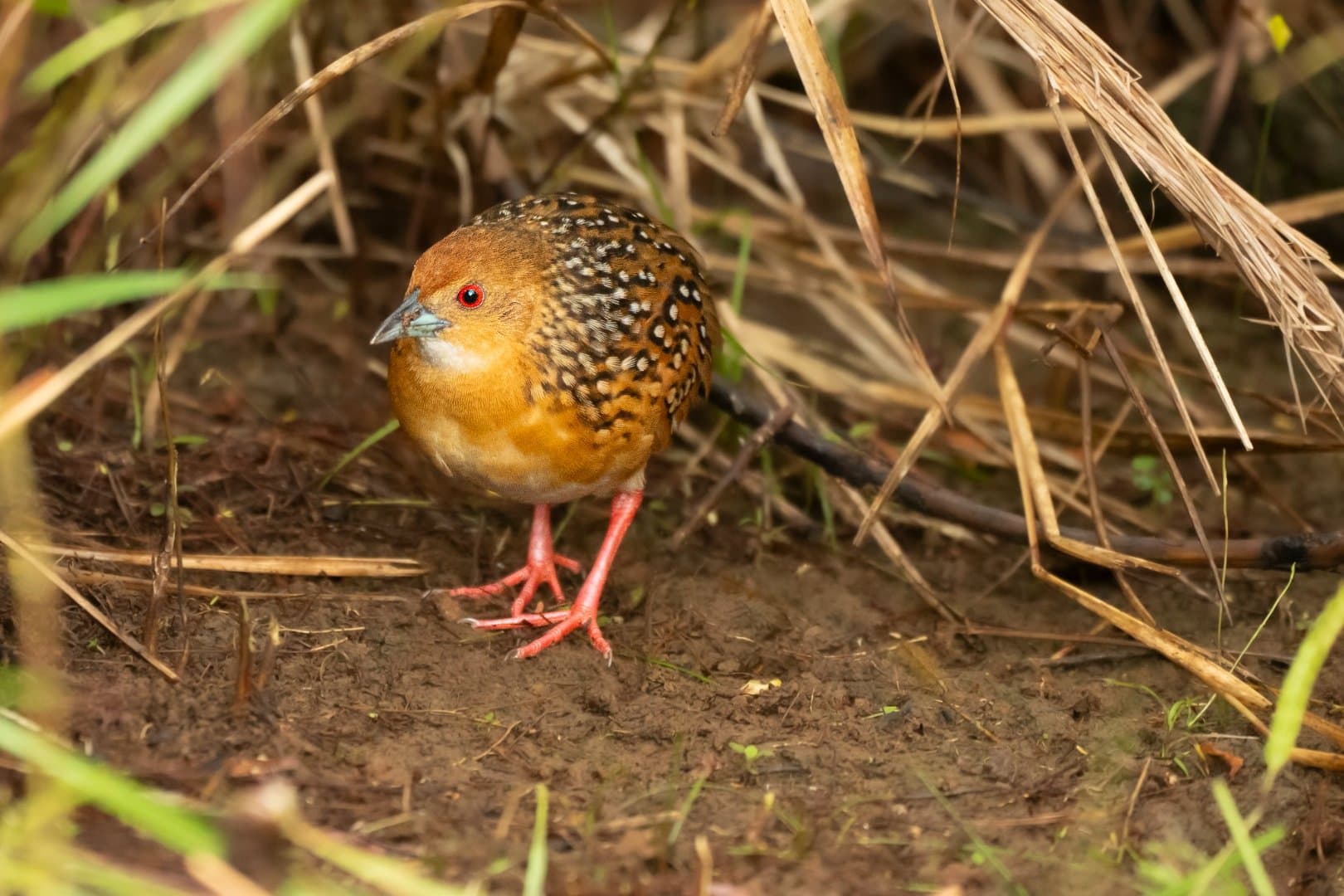
The Ocellated Crake (Micropygia schomburgkii) is one of the most elusive birds of the Neotropics. Small, secretive, and remarkably difficult to observe, this unusual member of the rail family spends most of its time moving through dense grassland vegetation. It is often heard calling from somewhere nearby, but actually getting a good look at it is another matter.
While Costa Rica is internationally famous for its tropical rainforests, colorful toucans, hummingbirds, and quetzals, some of its most interesting birds inhabit very different environments. The Ocellated Crake is one of them. It depends on open grasslands and savannas, habitats that are often overlooked by visiting birdwatchers.
In this article, we explore the distribution, habitat, behavior, and conservation of the Ocellated Crake, and discover how local knowledge can make it possible to observe this fascinating bird.
Where Does the Ocellated Crake Live?
The Ocellated Crake has a broad but highly fragmented distribution across Central and South America. Its range includes Costa Rica, Colombia, Venezuela, Guyana, Suriname, French Guiana, Brazil, Bolivia, Peru, Paraguay, and Argentina.
Despite this extensive geographical range, the species is not commonly encountered throughout these countries. Instead, it occurs at scattered localities, sometimes in relatively isolated grassland areas. Its secretive behavior and preference for dense vegetation also make it difficult to establish its actual distribution.
In Costa Rica, the species is particularly interesting because it is associated with localized grassland habitats rather than the country's better-known forest ecosystems. Finding it requires knowing where suitable habitat remains and understanding its behavior.
Habitat: A Specialist of Grasslands and Savannas
The Ocellated Crake inhabits open grasslands, savannas, and areas where grasses are mixed with low shrubs and other vegetation.
Depending on the region, it can occur in both relatively dry grasslands and seasonally flooded environments. In parts of Brazil, for example, it inhabits the Cerrado, a vast tropical savanna ecosystem characterized by grasslands, shrubs, and scattered trees.
The vegetation structure is particularly important. The Ocellated Crake needs sufficient cover to move around and remain protected from predators. Tall, dense grasses provide both shelter and opportunities to search for food.
This dependence on grassland ecosystems also makes the species vulnerable to changes in land use. The conversion of natural grasslands into agricultural land, together with inappropriate fire regimes, can reduce the availability and quality of its habitat.
Behavior: Easier to Hear Than to See
The Ocellated Crake belongs to the family Rallidae, which includes rails, crakes, and coots. Many members of this family are well known for their secretive habits and their ability to move through dense vegetation without being noticed.
The Ocellated Crake is an excellent example.
It spends much of its time walking through dense grassland vegetation, rarely venturing into open areas where it can be observed easily. Its movements can be surprisingly quick, and it may disappear into the grass almost as soon as it is spotted.
One of its most characteristic features is its vocalization: a relatively clear, penetrating trill that can carry across the grassland. This call is often the first indication that a bird is nearby.
However, hearing the bird does not necessarily mean that it will be possible to see it. It may continue calling while remaining completely hidden.
This is why finding an Ocellated Crake often requires patience, careful observation, and a good understanding of its movements.
Finding the Ocellated Crake in Costa Rica
For visiting birdwatchers, the opportunity to observe this species is particularly rewarding because it is not a bird that can easily be found by simply walking along a trail.
In our BirdnWild video, Karin joins Oscar, a local birding specialist who has spent approximately four years monitoring the Ocellated Crake.
Oscar has developed an intimate knowledge of the species and its habitat through repeated observations. He describes its movements as being similar to those of a rat moving through the savanna, an amusing but very effective way of explaining why it can be so difficult to see.
His work also goes beyond finding the bird for visiting photographers and birdwatchers. By monitoring the species and sharing his knowledge with local residents of his Indigenous community, he has helped increase awareness of the Ocellated Crake and the importance of the grassland habitats it represents.
Conservation: Protecting the Grasslands
According to BirdLife International, the Ocellated Crake is currently classified as Least Concern on the IUCN Red List. This classification reflects its extensive geographical range and estimated population size.
However, Least Concern does not mean that the species is free from conservation threats.
BirdLife International reports a decreasing population trend, with estimates suggesting a potentially significant decline. Among the threats identified are human-induced fires and the conversion of natural grasslands into other land uses.
Grassland ecosystems are sometimes perceived as degraded or unproductive landscapes, particularly when compared with forests. However, natural savannas and grasslands support specialized communities of plants and animals, many of which depend on maintaining the characteristic vegetation structure.
The Ocellated Crake is one of these specialists.
Protecting its habitat means maintaining healthy grassland ecosystems, preventing inappropriate burning practices, and ensuring that land-use changes do not eliminate the vegetation on which the species depends.
Local communities can play an important role in this process. When residents become familiar with the wildlife around them and recognize the ecological value of their natural environments, they can become important partners in conservation.
Oscar's monitoring work is a good example of how local knowledge can contribute to both wildlife observation and greater community awareness.
See the Ocellated Crake with a Local Expert
The Ocellated Crake is a perfect example of why local expertise makes such a difference in birdwatching.
A species that might remain completely hidden, even from an experienced birder unfamiliar with its habits, can become accessible with the help of someone who knows its movements, specific territories, and behavior.
If you are visiting Costa Rica and would like to observe or photograph this fascinating grassland specialist, you can join Oscar on his specialized Ocellated Crake tour.
Join Oscar on his specialized Ocellated Crake tour in Costa Rica:
https://birdnwild.com/tours/ocellated-crake-tour
At BirdnWild, we connect birdwatchers and wildlife photographers with expert local guides who know where to find the species you want to see.
BirdnWild – Local Guides. Global Conservation.