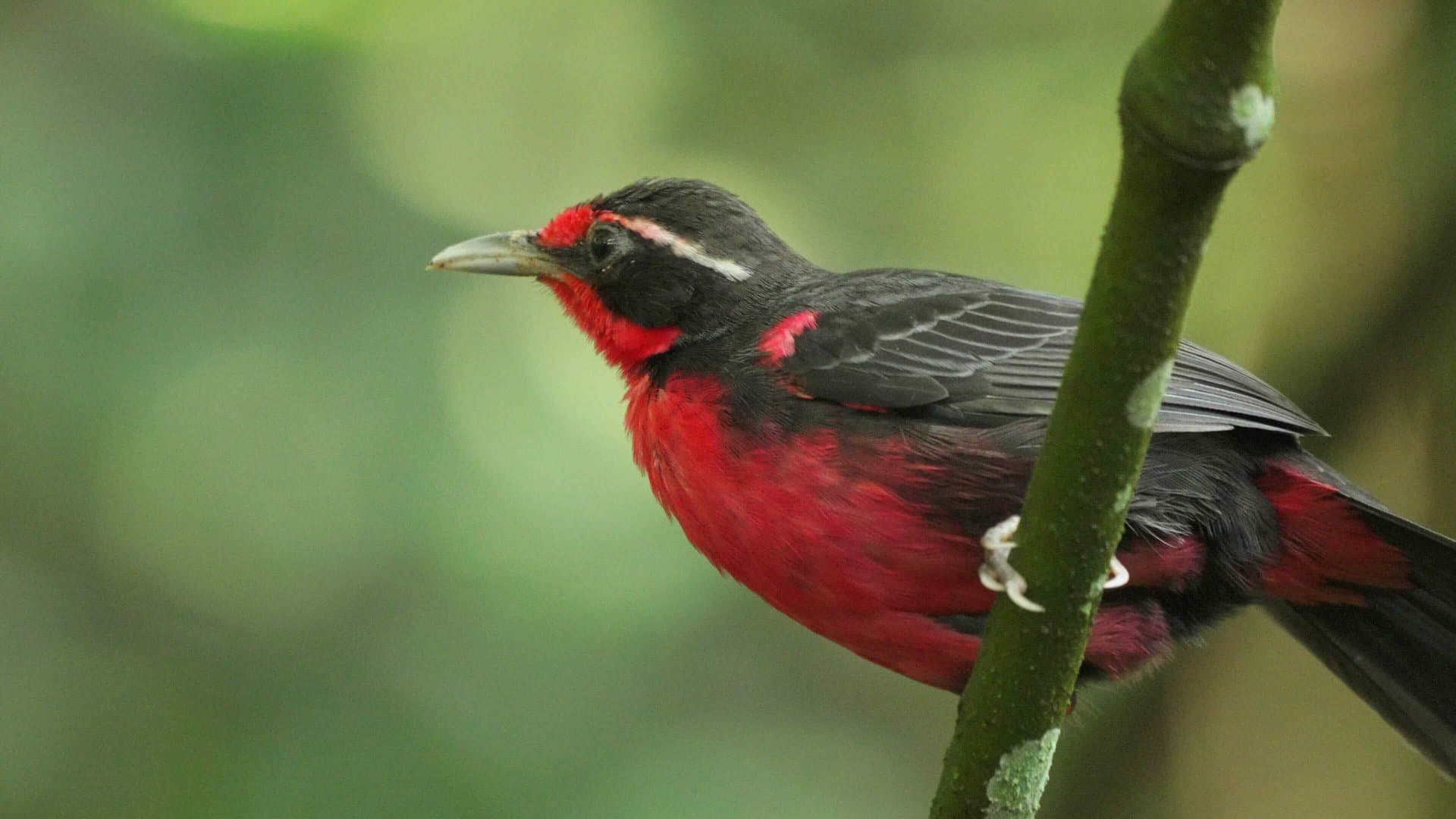
The Rosy Thrush-Tanager (Rhodinocichla rosea) is one of the most unusual birds a birdwatcher can hope to find in the Neotropics. Its striking colors, secretive behavior, and unusual evolutionary history make it a fascinating target for birders and wildlife photographers. But finding one is rarely easy.
Unlike many colorful tropical birds that can be spotted moving through the canopy, the Rosy Thrush-Tanager spends much of its time close to the ground, hidden among dense vegetation. Even in places where it occurs, a bird can be surprisingly difficult to see.
So, where can you find the Rosy Thrush-Tanager, and what does it take to observe this elusive species?
In our BirdnWild video, Karin meets Leandro, a local specialist from Costa Rica who has spent years monitoring these birds and learning about their behavior. His experience offers a fascinating look at the species and shows how specialized local knowledge can make the difference between searching without success and enjoying a memorable encounter.
An Unusual Bird with a Remarkable Evolutionary History
Despite its name, the Rosy Thrush-Tanager is not a typical thrush or tanager. Its unusual combination of characteristics reflects its distinctive evolutionary history: it is the sole living representative of the family Rhodinocichlidae. Its evolutionary relationships puzzled ornithologists for decades, as its physical characteristics did not fit neatly into the groups to which it was traditionally compared.
Genetic research eventually helped clarify its distinct evolutionary position, confirming that it represents a unique branch of the bird family tree.
Habitat and Distribution: Where Does the Rosy Thrush-Tanager Live?
The Rosy Thrush-Tanager has a discontinuous distribution across parts of tropical America, including Central America and northern South America. Its range is fragmented, and local populations can be separated by large areas where the species is absent.
It is generally associated with dense vegetation, including forest edges, thickets, secondary growth, and areas with a well-developed understory. The precise habitat used varies across its range.
Rather than spending much time in exposed positions, the species usually remains close to the ground, moving through tangled vegetation where it can forage and remain concealed.
This habitat preference has important consequences for birdwatchers. Knowing that the species occurs in a particular region is not enough: finding the right patch of vegetation and understanding where an individual regularly feeds can be essential.
Its patchy distribution also means that a site with a known, regularly observed population can be especially valuable for anyone hoping to see the bird.
Learning from Years of Monitoring the Rosy Thrush-Tanager
In our video, Karin meets Leandro, who began monitoring the Rosy Thrush-Tanager in 2021.
When he first started, observing the birds was extremely difficult. One individual took approximately eight months of regular observation, with visits lasting around three hours a day, before it became comfortable with his presence.
Over time, Leandro developed a detailed understanding of the bird's routines and behavior. He learned where it foraged, how it responded to familiar sounds, and how its movements changed throughout the day.
He now monitors around 30 pairs in the surrounding area.
As Leandro explains in the video, when a bird is feeding, it can sometimes continue its normal activities at close range, even searching for insects near his feet.
They also highlight an important distinction: becoming familiar with a particular bird through long-term monitoring is very different from simply approaching a wild bird to obtain a closer view. Leandro's observations developed over months of repeated visits, and they offer a rare insight into a species that very few birdwatchers and ornithologists know well.
How Local Knowledge Helped Protect the Rosy Thrush-Tanager in Costa Rica
Leandro's work has contributed to more than better birdwatching opportunities.
When the Rosy Thrush-Tanager population was discovered in the area featured in our video, the land had been designated for other uses. Further observations revealed the complexity of the birds' territories and the importance of maintaining suitable habitat.
Leandro spoke with the local pineapple company responsible for the land, explaining the significance of the population and its habitat requirements.
As a result, an area was set aside for the protection of the Rosy Thrush-Tanager.
This is an encouraging example of how local ecological knowledge can contribute to practical conservation. Monitoring a species can reveal not only where it lives, but also which areas are important for its survival and why they deserve protection.
For BirdnWild, this connection between wildlife observation, local expertise, and habitat protection is particularly important. Local guides often know their ecosystems in extraordinary detail, and their knowledge can help visitors appreciate the wildlife they encounter while supporting people who work closely with nature.
Tips for Finding and Photographing the Rosy Thrush-Tanager
If you are planning a birding trip with the Rosy Thrush-Tanager on your target list, a few considerations can improve your chances of a successful encounter.
1. Go with a guide who knows the species.
A guide who monitors the Rosy Thrush-Tanager can help you locate the right habitat, interpret its calls and movements, and choose a territory where the birds are accustomed to the presence of observers. This can improve your chances of enjoying good views without disturbing them.
2. Be prepared for low-light conditions.
Because the bird spends much of its time beneath vegetation, lighting can be challenging for photography and videography. A camera that performs well at higher ISO settings and a lens with a wide maximum aperture can be helpful.
3. Planning to film? Consider a camera and lens with effective image stabilization.
Because this species can move quickly through dense vegetation, setting up and stabilizing a tripod before filming may cost you valuable time. We found it much faster and more practical to use a camera and lens with effective image stabilization, allowing us to react quickly and capture footage as the bird moves through the vegetation.
4. Respect the bird's behavior.
Avoid chasing the bird, flushing it, blocking its movements, or using playback excessively to attract it. Never sacrifice the bird's well-being for a closer view or photograph.
Find the Rosy Thrush-Tanager with BirdnWild
For birdwatchers and wildlife photographers, finding the Rosy Thrush-Tanager is a very rewarding experience.
Its unusual evolutionary history, beautiful plumage, and secretive behavior make it a fascinating species to observe. Yet its elusive nature means that knowing where to look can make all the difference.
BirdnWild connects birdwatchers and nature photographers with expert local guides who know the wildlife and habitats of their regions.
Discover the Rosy Thrush-Tanager in Costa Rica with local guides: Book the Rosy Thrush-Tanager tour with Leandro.