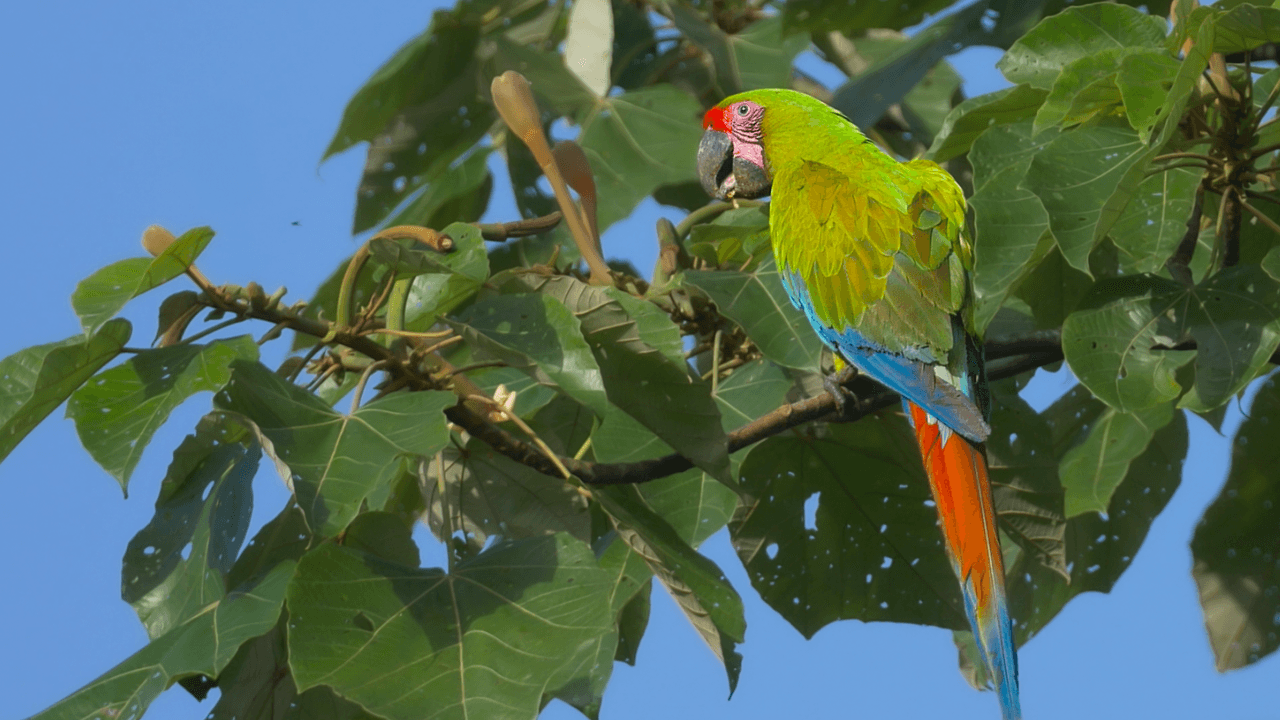
The Great Green Macaw (Ara ambiguus) is one of Costa Rica’s most spectacular and iconic birds. With its brilliant green plumage, powerful bill, and impressive size, this magnificent macaw is a favorite among birdwatchers and wildlife photographers visiting Costa Rica.
But the Great Green Macaw is much more than a spectacular bird to see in the wild. Its story is also a remarkable example of how habitat protection, conservation efforts, and local communities can work together to help recover a threatened species.
For birdwatchers looking for the Great Green Macaw in Costa Rica, the Caribbean lowlands — particularly the Sarapiquí and Boca Tapada regions — offer some of the best opportunities to observe this extraordinary species.
The Great Green Macaw: An Iconic Bird of Costa Rica
The Great Green Macaw is one of the largest parrots in the Americas. Its predominantly green plumage, blue and red markings, and massive dark bill make it unmistakable.
In Costa Rica, the species is strongly associated with the Caribbean lowlands and with one particular tree: the Mountain Almond (Dipteryx panamensis).
This relationship is one of the keys to understanding both the ecology of the Great Green Macaw and the conservation challenges it faces.
The Mountain Almond provides an important source of food, but mature trees also provide cavities where the macaws can nest. These enormous trees can take decades to reach maturity, meaning that the loss of even a relatively small number of suitable trees can have a significant impact on the species.
The Mountain Almond and the Great Green Macaw
Up to 80% of the Great Green Macaw's diet during key periods of the year can be associated with the seeds of the Mountain Almond (Dipteryx panamensis), making this tree an essential part of its habitat.
Historically, extensive deforestation dramatically reduced Mountain Almond populations in parts of Costa Rica. As the trees disappeared, the Great Green Macaw lost both an important food source and many of its potential nesting sites.
The decline of the tree and the decline of the macaw were therefore closely connected.
The situation began to change as Costa Rica strengthened environmental legislation and conservation efforts. The protection of the Mountain Almond became an important part of protecting the Great Green Macaw itself.
Today, cutting Mountain Almond trees is prohibited in Costa Rica, providing an important legal foundation for the long-term conservation of the species.
A Conservation Success Story in Sarapiquí
Sarapiquí has become one of the best-known regions in Costa Rica for observing the Great Green Macaw.
For local bird guides and communities, however, the recovery of the species is much more than a statistic.
Local guide Randy, whom we met for our BirdnWild video, remembers a time when seeing a Great Green Macaw was a rare event.
When he was growing up, he could sometimes go an entire month seeing only one or two macaws flying overhead. Today, Great Green Macaws can be observed much more regularly in the region.
The recovery of the Great Green Macaw has involved conservation organizations, government institutions, local communities, landowners, and people who have dedicated years to protecting the forests and trees on which the species depends.
It is also an excellent example of why conservation works best when local communities become part of the solution.
When Is the Best Time to See the Great Green Macaw in Costa Rica?
For birdwatchers and photographers planning a trip to Costa Rica, timing can make a significant difference.
One of the best periods to observe and photograph the Great Green Macaw is during the nesting season, which generally occurs during the dry season, from March through April and into early May.
During this period, the birds are particularly active around nesting sites. Their strong parental care can also provide fascinating opportunities to observe natural behavior, as adults leave and return to the nest while chicks may occasionally be seen calling for food.
Another excellent opportunity occurs when Mountain Almond trees are producing abundant fruit. When food is plentiful, Great Green Macaws can become especially active as they move between feeding sites.
Throughout the rest of the year, the species can still be observed flying between forest patches and feeding trees.
Photographing the Great Green Macaw
The Great Green Macaw is an extraordinary subject for wildlife photography.
Its bright green plumage contrasts beautifully with the tropical forest, while its large size and powerful flight make photographs of birds in flight particularly impressive.
However, photographing Great Green Macaws responsibly requires more than finding the right location.
Local knowledge can make a significant difference. Experienced birding guides know where the macaws regularly feed, roost, and nest, as well as how their behavior changes throughout the day and the year.
Just as importantly, responsible wildlife photography means observing the birds without disturbing their natural behavior — especially around nesting sites.
The goal should always be to obtain great photographs while allowing the birds to remain wild and undisturbed.
Great Green Macaw and Scarlet Macaw: Sharing the Forest
One of the fascinating sights for birdwatchers in Costa Rica is seeing Great Green Macaws feeding in the same areas as Scarlet Macaws.
Both species may visit fruiting trees, including Mountain Almond trees and the Beach Almond trees that can be found near some communities, creating an impressive spectacle of large, colorful parrots feeding together.
These encounters are a reminder that protecting a single tree species can benefit an entire community of wildlife.
A healthy Mountain Almond tree can provide food and nesting opportunities not only for Great Green Macaws, but also for many other birds and forest animals.
A Species Still Facing Global Threats
Despite the important conservation progress made in Costa Rica, the Great Green Macaw remains threatened across its range through Central America and northern South America.
Habitat loss continues to be one of its greatest challenges. The destruction and fragmentation of tropical forests reduces the availability of mature trees needed for feeding and nesting.
This is why protecting individual birds is not enough.
The long-term future of the Great Green Macaw depends on protecting forests, maintaining biological corridors, conserving mature Mountain Almond trees, and working together with the communities that live alongside these ecosystems.
Costa Rica's experience demonstrates that conservation can make a difference — but it also shows that protecting a species requires a long-term commitment.
Where to See the Great Green Macaw in Costa Rica
For birdwatchers visiting Costa Rica, the Caribbean lowlands are among the most important regions to look for the Great Green Macaw.
The Sarapiquí area is particularly well known for its bird diversity and offers excellent opportunities to explore tropical forests, rivers, wetlands, and agricultural landscapes that support an extraordinary variety of wildlife.
Finding a Great Green Macaw, however, is not simply a matter of visiting the right destination.
Knowing where and when to look, understanding the species' movements, and recognizing the calls of these large parrots can greatly increase the chances of a successful encounter.
This is where a knowledgeable local birding guide can make all the difference.
Experience the Great Green Macaw with BirdnWild
Would you like to see and photograph the Great Green Macaw in Costa Rica?
BirdnWild makes it easy:
In our tours section, choose “Great Green Macaw”, and explore the different tour options to find the experience that's right for you!
Click here to join Randy and discover the Great Green Macaw and other birds and wildlife around Sarapiquí.
By choosing a local guide, you are not only increasing your chances of finding the birds you are looking for — you are also supporting the people and communities whose livelihoods can be connected to protecting wildlife and its habitat.
Protecting the Future of the Great Green Macaw
The story of the Great Green Macaw in Costa Rica offers an important message of hope.
A species that was once extremely difficult to find in some areas can now be observed more regularly thanks to decades of conservation work.
But the story is not over.
The future of the Great Green Macaw depends on continuing to protect tropical forests, conserving Mountain Almond trees, maintaining habitat connectivity, and ensuring that local communities have a meaningful role in conservation.
The Great Green Macaw reminds us that when people protect the habitats on which wildlife depends, remarkable recoveries are possible.
And for birdwatchers, photographers, and wildlife lovers, every encounter with one of these magnificent macaws is an opportunity to appreciate why those efforts matter.
Happy Birding & Wildlife Observation!