By Sierra Goodman
birdnwild.com/guide/divine-dolphinCosta Rica is famous for its rainforests, volcanoes, monkeys, sloths, and incredible biodiversity. But some of the country's greatest wildlife encounters happen beyond the shoreline, in a world that remains largely hidden beneath the surface of the Pacific Ocean.
Whales and dolphins thrive along Costa Rica's Pacific coast, and nowhere is this more apparent than around the Osa Peninsula in the country's remote Southern Pacific region. Here, warm tropical waters, deep offshore habitat, productive coastal ecosystems, and an extraordinary diversity of marine life come together.
It is a place where humpback whales travel thousands of miles to give birth, where mothers teach their newborn calves how to navigate their watery world, and where dolphins can gather in breathtaking mega-pods numbering in the hundreds—and sometimes thousands.
I have been observing whales and dolphins in the waters around Drake Bay and the Osa Peninsula since 1998, and after nearly three decades on the ocean, there is one thing I know for certain: you never really know what the sea is going to give you.
That is part of its magic.
Why Is Costa Rica Such a Special Place for Whales and Dolphins?
Costa Rica lies within the Eastern Tropical Pacific, an incredibly productive marine ecosystem that supports an enormous variety of wildlife.
The waters surrounding the Osa Peninsula are especially remarkable. Coastal bays, river mouths, continental shelf habitat, deep offshore waters, and the edge of the continental shelf create dramatically different environments within a relatively small area.
That diversity of habitat means diversity of cetaceans.
More than 17 species of whales and dolphins have been documented within the Osa Peninsula Important Marine Mammal Area. Depending on where you travel and the time of year, encounters can range from coastal spotted and bottlenose dolphins to huge offshore dolphin aggregations, humpback whales, false killer whales, pilot whales, rough-toothed dolphins, Bryde's whales, sperm whales, and deep-diving species such as Cuvier's beaked whales.
And then there are the humpbacks.
Costa Rica has something very unusual: humpback whales migrate here from both the Southern and Northern Hemispheres.

Two Humpback Migrations Meet in Costa Rica
Most famous humpback whale destinations receive a seasonal migration from one major population. Costa Rica is unusual because its tropical Pacific waters are used by whales migrating from opposite ends of the planet at different times of year.
Southern Hemisphere humpback whales travel north from feeding grounds associated with Antarctica and the Southern Ocean, reaching Costa Rican waters primarily from approximately July through October.
Later, Northern Hemisphere humpbacks migrate south from feeding areas off western North America, with whales occurring in Costa Rica primarily during the Northern Hemisphere winter.
This means that there can be humpback whales somewhere along Costa Rica's Pacific coast during much of the year.
These warm tropical waters serve an entirely different purpose from their cold-water feeding grounds.
Humpbacks undertake their tremendous migrations largely to reproduce. Costa Rica is a place for mating, giving birth, nursing calves, and preparing those calves for the enormous journey that eventually awaits them.
Seeing a humpback whale is impressive anywhere. Seeing a tiny newborn beside its mother and realizing that this baby will have to become strong enough to undertake a migration of thousands of kilometers is something else entirely.
Humpback Whales: Giants With Remarkably Complex Lives
Humpback whales (Megaptera novaeangliae) are among the most charismatic whales in the world.
Adults can reach approximately 15 meters (50 feet) in length, with females generally larger than males. Despite their enormous size, humpbacks can be astonishingly acrobatic.
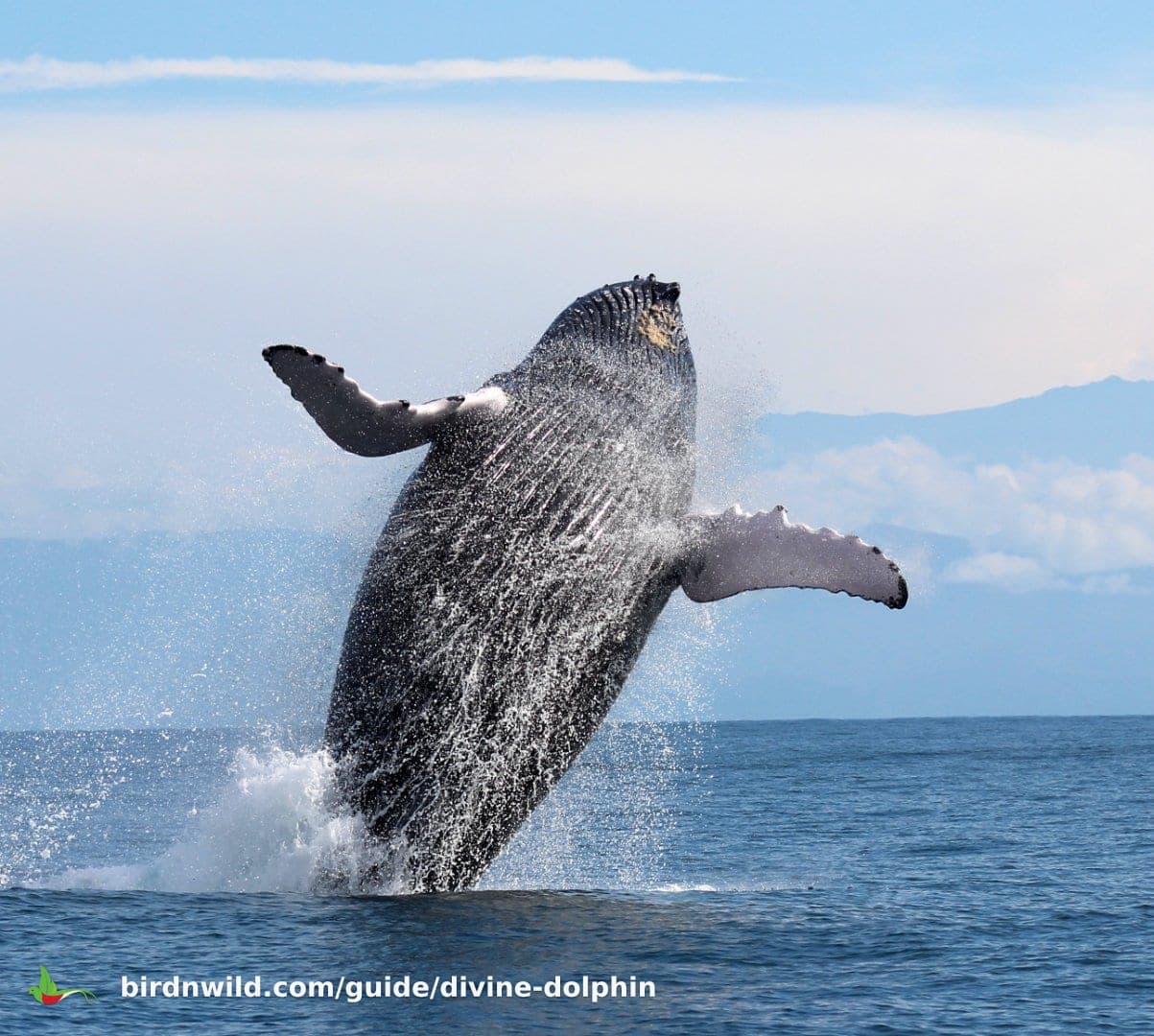
They breach, sometimes launching nearly their entire bodies out of the ocean. They slap their enormous pectoral fins against the surface, lobtail with their flukes, spyhop vertically out of the water, and interact with one another in ways we are still working to understand.
One of my favorite things to observe is a young calf discovering its body.
Baby humpbacks frequently seem to practice. They breach, roll, slap their tails, and experiment with movements that initially look somewhat uncoordinated. As the weeks pass, you can actually see them growing larger, stronger, and more capable.
When you are fortunate enough to encounter the same mother and calf repeatedly throughout a season, you get to watch that transformation unfold.
Females generally give birth to a single calf following a gestation of approximately 11 months. A newborn is already around 4 to 5 meters (13–16 feet) long. It nurses on extremely rich milk while growing rapidly and stays closely associated with its mother during the first months of its life.
For the mother, this is an enormous energetic investment. She has migrated thousands of kilometers, given birth, is producing milk for a rapidly growing calf, and will eventually need to make the long journey back toward productive feeding grounds.

The Songs Beneath the Sea
One of the most extraordinary aspects of humpback whale biology is their song.
Male humpbacks sing long, complex sequences of sounds during the breeding season. All males within a population broadly share the same evolving song, although that song gradually changes over time.
Scientists continue to investigate precisely what the song communicates and the various roles it may play in reproduction and competition.
A hydrophone—essentially an underwater microphone—allows us to enter that acoustic world.
Sometimes we stop the boat, shut off the engines, lower the hydrophone, and listen.
Suddenly, an ocean that appeared quiet is anything but.
Moans, cries, pulses, and other extraordinary sounds travel through the water. A singing humpback can sometimes be heard from miles away.
After decades of doing this, hearing a whale sing still affects me. It is a reminder of how limited our normal perception of the ocean really is. We see only its surface. Beneath us is an entire acoustic universe of animals communicating across enormous distances.
But Don't Forget the Dolphins!
Whales may be the celebrities of Costa Rica's marine world, but dolphins are every bit as important—and unlike migrating humpbacks, dolphins can be encountered throughout the year.
In fact, some of the most spectacular cetacean encounters I have ever experienced have involved dolphins.
Several species occur around the Osa Peninsula and Drake Bay, including pantropical spotted dolphins, bottlenose dolphins, spinner dolphins, common dolphins, and rough-toothed dolphins.
False killer whales, despite their name, are actually members of the dolphin family. We occasionally encounter these large, powerful dolphins as well, sometimes in remarkably social and interactive groups.
Each species has its own character and behavior.
Bottlenose dolphins are powerful, intelligent, and endlessly fascinating. Spotted dolphins can be incredibly curious and interactive around boats. Spinner dolphins are famous for their spectacular aerial behavior, leaping clear of the water and rotating around their longitudinal axis.
The Central American spinner dolphin found in this region is a distinctive form associated with the Eastern Tropical Pacific.
Then there are the mega-pods.

When Hundreds—or Thousands—of Dolphins Fill the Ocean
One of the most extraordinary phenomena we encounter off the Osa Peninsula is the formation of enormous dolphin aggregations.
We call them mega-pods.
During certain times of year, particularly in offshore waters, dolphins may gather in groups numbering in the hundreds and occasionally into the thousands.
It is difficult to describe what this looks like until you have seen it.
At first, you might notice splashes on the horizon. As you approach, you realize the splashes extend much farther than you initially thought.
Then there are dolphins in front of you.
Dolphins behind you.
Dolphins riding the bow.
Dolphins surfing the wake.
Dolphins leaping in the distance in every direction you look.
Sometimes the ocean appears to be alive with them.
These large gatherings are often associated with feeding opportunities. In the open ocean, prey occurs in patches, and dolphins may travel considerable distances searching for productive areas. When conditions are right, smaller social groups can converge into enormous aggregations.
Seabirds may join the activity overhead. Tuna and other predatory fish may be feeding below. Different dolphin species sometimes come together in the same general area.
These are not captive animals performing for people. They are wild dolphins living extraordinarily complex social lives, traveling, hunting, mating, raising young, and communicating in an oceanic environment that we are privileged to visit for only a few hours.
Some days, a mega-pod stretches toward the horizon.
For me, those days can be every bit as breathtaking as seeing a humpback whale breach.

What Species of Whales and Dolphins Can You See in Costa Rica?
Humpback whales are the species most visitors associate with whale watching in Costa Rica, but the country's cetacean diversity extends far beyond humpbacks.
In the waters around the Osa Peninsula, species documented over the years include:
- Humpback whales
- Bryde's whales
- Sperm whales
- Cuvier's beaked whales
- Dwarf sperm whales
- Short-finned pilot whales
- False killer whales
- Killer whales
- Pantropical spotted dolphins
- Common bottlenose dolphins
- Spinner dolphins
- Common dolphins
- Rough-toothed dolphins
Some are frequently encountered, others are seasonal, and some are rare enough that seeing one is an exceptional event.
This is an important part of ethical wildlife watching: nothing is guaranteed.
Wildlife doesn't operate according to our vacation schedules.
A day that begins with everyone hoping to see a humpback may instead produce hundreds of spinner dolphins, a group of false killer whales, feeding seabirds, sea turtles, and rays. Another day may bring a mother humpback and newborn calf within minutes of leaving shore.
You go looking, you pay attention, and you allow the ocean to decide what kind of day it is going to be.

When Is the Best Time to See Whales and Dolphins in Costa Rica?
The answer depends upon what you most want to see.
For Southern Hemisphere humpback whales, July through October is the primary season in southern Costa Rica, with August and September generally excellent months.
Northern Hemisphere humpbacks begin arriving later in the year and may be encountered through the Northern Hemisphere winter and into early spring. Their numbers in southern Costa Rica tend to be lower than those of the Southern Hemisphere population.
For dolphins, there really isn't a "dolphin season."
Dolphins are here year-round.
Different species, ocean conditions, and food availability influence what we encounter, but dolphins are an integral part of this ecosystem throughout the year.
For people dreaming of enormous dolphin groups, the period from approximately January through March can be particularly exciting in the offshore waters around Drake Bay. Some of our most extraordinary encounters with hundreds or thousands of dolphins have occurred during this period.
There is therefore no single "best" month for everyone.
If humpback mothers and calves are your priority, come during the peak Southern Hemisphere season. If huge dolphin aggregations excite you, consider the early months of the year. If your priority is simply experiencing wild cetaceans and accepting whatever the ocean offers, there is something to discover throughout the year.
Where Is the Best Place to Go Whale and Dolphin Watching in Costa Rica?
Whales and dolphins occur along much of Costa Rica's Pacific coast, and several areas offer whale-watching excursions.
The Southern Pacific is particularly important for cetaceans, however, and the Osa Peninsula and Drake Bay offer an unusual combination of coastal and offshore habitat.
This matters.
If a boat is capable of exploring farther offshore rather than remaining exclusively near the coast, the possibilities change dramatically. Coastal waters may hold humpback mothers and calves, bottlenose dolphins, and spotted dolphins, while deeper offshore waters open the door to pelagic species and enormous dolphin aggregations.
The Osa Peninsula has been internationally recognized as an Important Marine Mammal Area (IMMA) because of its exceptional importance to cetaceans, including reproductive and calving habitat for humpback whales from both hemispheres and habitat for an extraordinary diversity of whale and dolphin species.
I am especially proud that years of research and data collection from our work in these waters helped contribute to this designation.
For me, it was an important recognition of what we had been documenting for decades: these waters are not simply a place where whales and dolphins happen to pass through. They are significant marine mammal habitat worthy of recognition and protection.
The official Osa Peninsula IMMA designation recognizes habitat for more than 17 cetacean species. It identifies three particularly important types of habitat: the continental shelf used by humpbacks and several dolphin species; deep oceanic waters used by sperm whales, pilot whales, and other deep divers; and the transitional habitat around the shelf break, which is particularly important for offshore pantropical spotted dolphins.
You can learn more about the Osa Peninsula Important Marine Mammal Area on the official Marine Mammal Protected Areas Task Force website:
Osa Peninsula Important Marine Mammal Area
The Osa Peninsula is also one of the most biologically spectacular places in Costa Rica on land. The rainforest reaches right to the Pacific, so a day on the water can begin with scarlet macaws flying overhead and continue with dolphins racing beneath the bow.
There aren't many places where rainforest and open-ocean biodiversity meet quite like this.
Responsible Whale and Dolphin Watching
The privilege of encountering wild cetaceans comes with responsibility.
Whale and dolphin watching should never be about getting as close as possible at any cost. The goal should be to observe natural behavior while minimizing our impact on the animals.
Responsible operators should avoid chasing animals, cutting across their direction of travel, separating individuals from a group, or repeatedly positioning a boat directly in their path.
Extra caution is essential around mothers and calves.
Boat speed matters. Noise matters. The number of boats surrounding an animal matters.
And experienced observation matters.
Cetaceans communicate through behavior. Changes in direction, prolonged dives, avoidance, rapid movement, or repeated changes in behavior can all tell us something about how an animal is responding to our presence.
Sometimes the best decision a captain or guide can make is simply to back away.
There is another side to responsible whale watching as well: science and conservation.
Photo identification allows researchers to recognize individual whales through the unique markings and shapes of their tail flukes. Dolphins can also be identified through dorsal-fin markings, scars, and other characteristics.
Over time, these records can reveal movements, associations, population patterns, and site fidelity.
Whale- and dolphin-watching boats can become valuable platforms for collecting this information—turning tourism into an opportunity to learn more about the animals people have traveled so far to see.
In our case, that long-term research has gone beyond simply recording what we encounter. Decades of data from these waters have contributed to the scientific understanding of the region and helped provide evidence supporting recognition of the Osa Peninsula as an Important Marine Mammal Area.
For me, that is one of the most meaningful outcomes of all these years on the water. We don't just want people to fall in love with whales and dolphins. We want the knowledge gained from observing them to help protect the ocean they depend upon.
Choosing a Responsible Whale and Dolphin Tour
When choosing a tour, look beyond the promise of seeing animals.
Ask whether the operator uses knowledgeable naturalist or marine biology guides. Find out whether they follow responsible approach practices and whether wildlife observation is actually their specialty.
A hydrophone can add an entirely different dimension during humpback season. An operator that participates in research or contributes identification photographs and sighting information can also help turn tourism into meaningful conservation data.
Be cautious of anyone promising guaranteed encounters with a particular species. The unpredictability of wildlife is not a disadvantage—it is precisely what makes a genuine wild encounter meaningful.
And don't automatically assume that the boat that gets closest provides the best experience.
Often, it is exactly the opposite.
Nearly Three Decades on the Water—and Still Surprised
I began observing dolphins and whales around Drake Bay in 1998.
You might imagine that after thousands of hours at sea, encounters would eventually become routine.
They haven't.
I have watched newborn humpbacks grow throughout a season. I have listened to whales singing beneath the boat. I have seen dolphins stretching across the ocean as far as I could see. I have watched whales breach repeatedly, mothers patiently care for calves, dolphins surf waves for what seems like pure joy, and different cetacean species interact in ways no itinerary could ever predict.
There are days when we search for hours.
There are other days when the ocean seems determined to show us everything at once.
And there are moments that still leave everyone on the boat silent.
Nearly 30 years of watching these animals has taught me that knowing more about them doesn't diminish the wonder.
It deepens it.
Understanding that the mother humpback beside you may have traveled thousands of kilometers while pregnant makes seeing her calf more extraordinary.
Understanding the complicated social relationships within a dolphin community changes the way you see a group swimming beside the boat.
Understanding how sound travels through the ocean changes the experience of hearing a whale sing.
And understanding the threats these animals face makes protecting their habitat much more urgent.
Come for the Whales. Fall in Love With the Dolphins, Too.
Costa Rica deserves its reputation as an extraordinary whale-watching destination.
Two humpback populations use these tropical waters. Mothers give birth along the coast. Calves spend their earliest months growing strong enough for one of the greatest journeys of their lives.
But the whales are only part of the story.
The dolphins are here too—throughout the year.
Sometimes ten.
Sometimes fifty.
Sometimes hundreds.
And every so often, the horizon erupts and you find yourself surrounded by a living ocean of dolphins numbering into the thousands.
That is the beauty of whale and dolphin watching in Costa Rica, particularly around the wild waters of the Osa Peninsula.
You never know exactly what you are going to find.
You simply head out to sea, keep your eyes on the horizon, listen to the ocean—and see who comes to meet you.