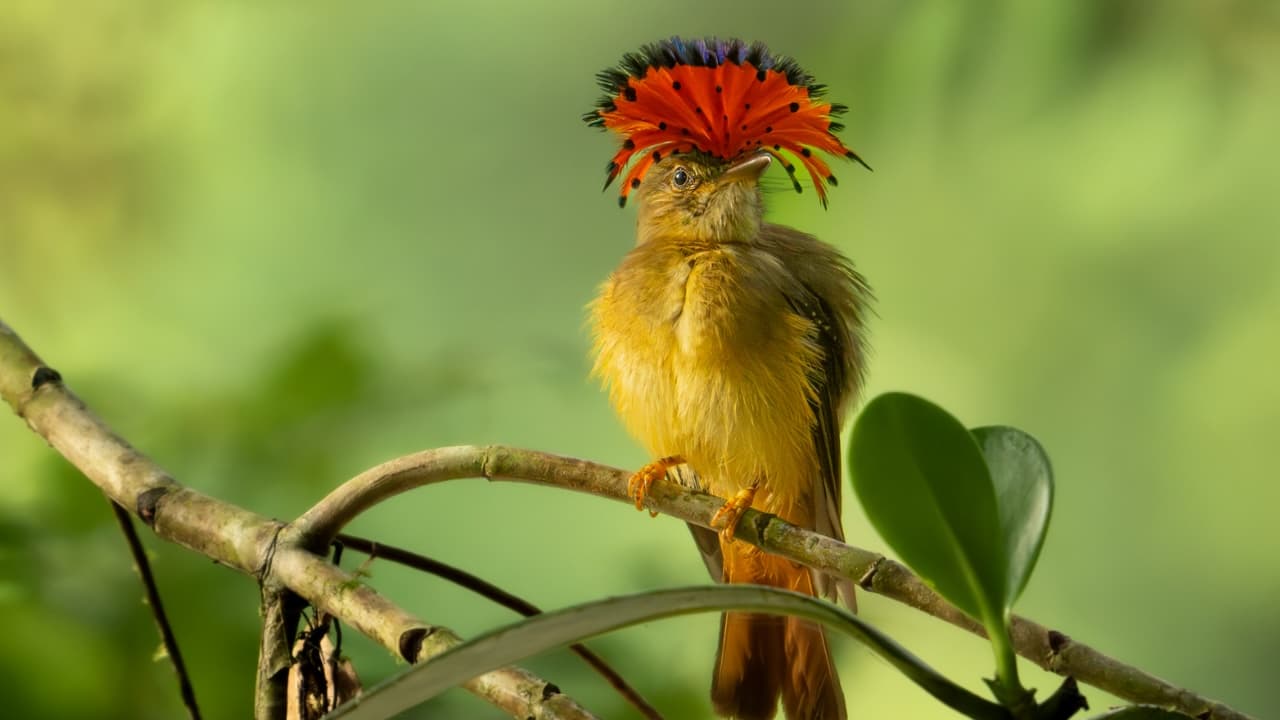
In the dim understory of tropical forests, the Tropical Royal Flycatcher (Onychorhynchus coronatus) is easy to overlook.
Like many flycatchers, it spends much of its time quietly moving through the vegetation, often perching inconspicuously while searching for insects. Its plumage is mostly brown and olive, providing excellent camouflage among branches and foliage.
But this apparently modest bird has one of the most remarkable displays of any flycatcher in the Neotropics.
Hidden beneath its subdued plumage is a spectacular crest that the bird can raise in a sudden, dramatic display. Seeing—and especially photographing—that moment requires more than simply finding the bird. It requires patience, careful observation, and an understanding of its behavior.
That is exactly what we experienced while photographing a Tropical Royal Flycatcher with local bird photography expert Sergio, who has been monitoring the species and its nests for many years.
A Flycatcher with a Spectacular Secret
At first glance, the Tropical Royal Flycatcher does not look particularly unusual. Its cryptic brown and olive plumage helps it disappear into the forest understory, where it can remain remarkably difficult to notice even when it is relatively close.
The crest changes everything.
When fully displayed, the crest reveals bright colors that are normally hidden. The male shows red in the crest, while the female's crest contains yellow. Because the crest is usually kept folded and is displayed only under particular circumstances, seeing it fully open is a special behavioral moment rather than something that happens continuously.
This is one reason why photographs of a Tropical Royal Flycatcher with its crest completely open are so sought after.
Why Does the Tropical Royal Flycatcher Open Its Crest?
The crest is not simply an ornamental feature. It is part of the bird's communication system.
According to Sergio, who has monitored the species and its nests for around a decade, one of the situations in which the crest may be displayed is during interactions between the male and female. The male may preen near the female and then raise his crest.
The birds can also display the crest when another bird approaches and they perceive it as a threat.
The sudden appearance of the bright crest can therefore change the visual impression of the bird completely. A bird that was almost invisible a moment earlier suddenly presents a conspicuous signal.
This also explains why simply locating a Tropical Royal Flycatcher does not guarantee a photograph of the crest. The photographer has to be ready for a behavioral event that may last only a very short time.
Photographing a Tropical Royal Flycatcher
Our visit was made possible by Sergio's long-term knowledge of the birds.
He had been monitoring the nest we visited since construction began, giving him an unusually detailed understanding of the birds' behavior and routines.
For a photographer, this kind of local knowledge can make an enormous difference.
Sergio knew the area, the nest, the birds, and the times when particular behaviors were most likely to occur. Based on his experience, the best period for photographing the birds was in the morning, approximately between 6:00 and 9:30 a.m.
Being in the right place at the right time is particularly important with a species like this. The bird may spend considerable time simply perching or moving through the vegetation, while the crest display itself can be brief.
The key is therefore not to chase the bird through the forest, but to find a suitable position, remain patient, and watch its behavior.
Watch the Bird, Not Just the Camera
One of the most useful lessons from photographing this species is the importance of observing behavior before pressing the shutter.
If the bird begins preening, for example, it may be worth paying particularly close attention. Sergio knew that after the male preens near the female, there can be an opportunity for a crest display.
The same applies when another bird enters the area. A territorial or defensive interaction can sometimes trigger the spectacular opening of the crest.
For photographers, this means that understanding the sequence of behaviors can be more valuable than simply having the longest lens or the fastest camera.
A Challenging Subject for Wildlife Photography
The Tropical Royal Flycatcher presents several challenges.
First, its preferred habitat is often dense forest understory. Vegetation can obstruct the bird or create distracting backgrounds, and the subdued plumage can make focusing difficult.
Second, the bird's most spectacular feature is not visible all the time. A photograph of a perched Tropical Royal Flycatcher can be relatively straightforward compared with capturing the bird with its crest fully extended.
And finally, the photographer has to be prepared for the moment to happen quickly.
A fast shutter speed can help freeze the crest as it opens, while a lens with good low-light performance is useful in the darker conditions of the forest understory. But equipment alone cannot create the photograph.
Patience and knowledge of the bird's behavior are fundamental.
The Importance of Responsible Nest Photography
Because this species nests in the forest and its breeding behavior is one of the best opportunities to observe the crest display, photographers should take particular care around active nests.
The goal should always be to observe without changing the birds' behavior.
That means keeping a respectful distance, avoiding unnecessary movement or noise, never touching or manipulating vegetation around a nest, not using any playback, and following the guidance of an experienced local guide or researcher.
A good wildlife photograph is not worth disturbing a breeding pair.
In fact, working with someone who has monitored the birds for years can help photographers understand not only where to position themselves, but also when it is appropriate to approach—and when it is better to stay away.
Where Can You Find the Tropical Royal Flycatcher?
The Tropical Royal Flycatcher has a broad distribution across tropical regions of Central and South America, although its taxonomy and geographic variation are more complicated than the common name might suggest.
It is associated primarily with forest habitats, including humid lowland and foothill forests, where it forages in the understory and lower levels of the vegetation.
Its distribution makes it a potential target for birders traveling through several countries in the Neotropics. However, finding the species and photographing its crest are two different challenges.
As with many tropical forest birds, local knowledge can greatly improve the chances of a successful encounter.
More Than a Beautiful Photograph
For us, photographing the Tropical Royal Flycatcher was not simply about getting a photograph of a colorful crest.
The experience demonstrated how much can be learned from spending time with someone who knows a species intimately.
Sergio's knowledge came from years of monitoring nests and observing the birds' behavior. That experience allowed us to recognize the small clues that preceded the display—and to be ready when the moment finally came.
The result was a brief but extraordinary transformation: a quiet, cryptically colored flycatcher suddenly revealing a bright red or yellow crest.
For a wildlife photographer, these are the moments that make patience worthwhile.
Photograph the Tropical Royal Flycatcher with a Local Expert
Would you like to see and photograph the Tropical Royal Flycatcher yourself?
BirdnWild connects birdwatchers and wildlife photographers with local guides who know where to look, how to approach the habitat responsibly, and how to interpret the behavior of the species they specialize in.
Explore tours where you may see the Tropical Royal Flycatcher: https://birdnwild.com/search?species=tropical-royal-flycatcher
Explore the Tropical Royal Flycatcher photography tour with Sergio: https://birdnwild.com/tours/tropical-royal-flycatcher-photography
Sometimes the difference between simply seeing a bird and capturing a remarkable behavioral moment comes down to one thing: knowing what to watch for.